

Imbolc
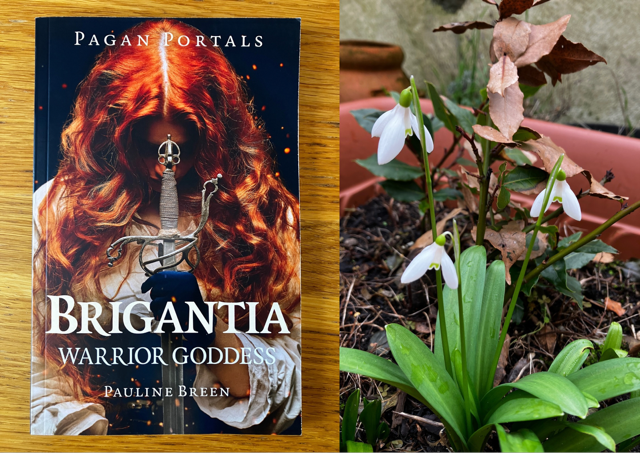
Snowdrops at dawn and my whispered wishes to a goddess of hearth & home

I’m enveloped in darkness as I stand in the frosty garden, wrapped in a warm dressing gown, listening to the birds as they herald the dawn. The soft glow from a tealight sits in the palm of my hand as I breathe in the cold morning air, enjoying the privacy of my garden. A moment between me, the earth and the snowdrops in front of me. I pour an egg cup of milk onto the soil, admire the pure white flowers, look into the flickering candle and feel a deep sense of gratitude for all of my blessings. This is how I like to celebrate Imbolc, a sacred pause witnessed only by me, the garden and a goddess, while the rest of my family sleep. In the last few years I find the whispers leaving my lips are words of thanks and hopeful wishes, directed to Brigid, the goddess of hearth and home, asking for strength, resilience and a peaceful heart to counter a fearful mind. Who better than a fire wielding Celtic goddess to help me through the end of winter?
To be honest with you I’m not committed to any particular faith or path, I like to dabble in them all and hold on to the parts that resonate with me. What I have discovered is that leading a secular lifestyle creates a void of spiritual connection, my soul seeks nourishment in ways our man-made world can’t provide for. So I look to nature and find solace in the beauty, the resilience and the power of the natural world. I’ve found what the faithful have, that the non-religious (like me) lack is celebration! The festivals and markers in the year that bring people together to give thanks, to share and to appreciate each other. This is what sees me through a dark winter, the opportunity to celebrate, in little ways that make life feel special. The pagan wheel of the year provides these prompts, to notice the changing seasons and make the most of nature’s offerings and so I celebrate them. Today is Imbolc and if the word is unfamiliar, let me introduce you to Brigid and explain why I’m offering milk to snowdrops!
Imbolc is a fire festival which falls on the eve of February 2nd and marks the midpoint between the winter solstice and spring equinox. Imbolc is Gaelic, meaning Ewe’s Milk or In the Belly, referring to the sheep heavily pregnant with their lambs and heralding the fertility of spring. Many Imbolc offerings are made to Brigid and the two become closely linked once you look into the traditions surrounding these early signs of spring.
There are many variations and pronunciations of Brigid, such as Brig, Bridget, Breed, and Bride but Brigid seems the most popular so let’s go with that. Depending on your sources or beliefs, Brigid may be an ancient Celtic goddess or a Christian saint, whom was made the patroness Saint of Ireland. They may have been two entirely separate entities that coincidentally share the same name or the saint’s pagan father may have named her after the goddess, or it may have been a convenient connection when Irish pagans were being converted from their polytheistic Celtic beliefs to Christianity.
Saint Brigid was born in Ireland, in the year 451, to a chieftain father, a slave mother and grew up with druids. She went on to perform many miracles, the key one (from an Irish perspective) being to change water into beer. She converted to Christianity and became Ireland’s first nun, eventually establishing an abbey in Kildare, under the shade of an oak tree and close to a sacred well. This location is where the goddess vs saint stories interconnect, as this abbey was built upon an ancient axis of the midwinter sunrise, a place sacred to the Celts called Cill Dara (Kildare), meaning Church of the Oak and for a long time it was a place of worship for a grove of druids. 19 of these female druids would tend to a perpetual flame in the name of their goddess Brigid. Coincidently (or not) when Saint Brigid died in the year 525, 19 nuns tended to a perpetual flame in her honour, which continued for a thousand years until it was extinguished during the reformation in the 16th century. However if anyone is saddened by this, you’ll be happy to hear Brigid’s flame was relit by two nuns in 1993 and an Imbolc celebration is held there every year.
As a Celtic goddess, Brigid appeals to me as a healer and protector of children and mothers, a goddess of midwifery, childbirth and the hearth and home (all of which has become a big part of my life in recent years). But she casts a wide net and is also the patron saint of poets, blacksmiths, sailers, fugitives and has a tendency to bless beer brewing, so she has a lot of followers.
She is often depicted as an auburn haired triple goddess, meaning that she can appear in three different forms, a maiden, a mother and a crone. I’m not keen on the word crone, in this context I think maiden, mother and grandmother would be more apt, the latter being wise and maternal rather than the wicked old hag straight out of a pantomime. A triple goddess figure usually represents the three phases of a woman’s life cycle and the phases of the moon - the waxing moon, full moon and waning moon.
Brigid rules over the elements of fire and water, and classed as a solar diety. The Christian name for her feast day is Candlemas. Her connection with water explains why many sacred springs and wells are dedicated to her across the British Isles and perhaps it’s not a coincidence that the ruling star sign this month is Aquarius, the water bearer.
It’s surprising how her presence still surrounds us but we may not be aware of it. There is a church dedicated to her in London’s Fleet street called Saint Bride and even the name Britain roots from her name. The Brigantes were the largest Celtic tribe to occupy the British Isles in pre-Roman times and they were named after the goddess they worshipped; Brigantia. Over time the land under their feet evolved from Brigantium to Britain.
If the last snippet piqued your interest I recommend Brigantia, Warrior Goddess by Pauline Breen (pictured below), a book I’ve been saving for Imbolc, to be enjoyed under a blanket, accompanied by a mug of golden milk and an early night. Bliss!

Your writing is lovely. I had never heard of Imbolc prior to this year. Its all quite fascinating how so many traditions overlap.